
 Matt Walsh
The internet is bigger than ever by any objective metric. More than a billion websites exist now. In 2010, there were just 250 million. Yet, for all the growth, the internet also feels much smaller and more restrictive than ever.
I was checking something like 20 different websites on a regular basis a decade ago. There was a thing called “surfing the web,” which is a phrase you don’t hear much anymore. Today, I check maybe two or three websites. I think most people have had a similar experience.
We’ve been bombarded with so many different apps and websites for more than a decade. Now we’ve decided we don’t need most of them. So instead of following a dozen independent bloggers or sites, people are scrolling Instagram and X. They’re talking to AI. If they want to spend some money, they’re subscribing to The Wall Street Journal or The New York Times, or maybe a premium Substack or two.
Our information is coming from a very concentrated handful of sources. Therefore, we are extremely easy to manipulate in ways most people probably don’t realize. This is the exact opposite of the original promise of the internet, but this is where we are.

How exactly did this happen? And how significant is the problem, really? To answer these questions, we’ll begin in Russia, which is still waging some kind of war in Ukraine — a war that, simply based on the fact that it’s still going on, we can assume Russia must be losing.
Russia’s economy is 10 times the size of Ukraine’s, and Russia has nearly four times the population — and yet, they’ve apparently been on the defensive for quite some time now. In fact, Ukraine has been striking targets deep in Russian territory, with total impunity. They’ve been ignoring the Trump administration, which doesn’t want Ukraine to escalate the conflict. For a very small, notoriously corrupt country, Ukraine is punching well above its weight.
What’s worth discussing is that Ukrainian drones are now going after Russian data centers (which handle a significant amount of automated online activity) when they’re not bombing refineries and spiking the price of diesel. In the past few days, Ukraine has bombed at least three data centers belonging to a technology company called Yandex, which is Russia’s equivalent to Google (in the sense that, in Russia, it handles much more traffic than Google does). The data centers were located within about 100 to 200 miles of Moscow, so these were aggressive strikes.
Ukraine’s President Volodymyr Zelensky claimed that swarms of Russian bots had been taken offline because of the attacks. In fact, he said so many bots had been disabled that “a lot of people noticed it,” casually browsing the internet. This was his victory lap from an event in Warsaw:
When we started responding to Russia’s operation against our data centers, and when our strikes reached Yandex’s data centers, it suddenly became a little easier to breathe on many social media platforms. A lot of people noticed it. There was less hate, less division, and fewer provocations.
Because there were fewer bots. And it’s pretty clear where those bots were coming from – if they disappeared when Yandex went offline. This proves, again and again, that Europe is not the source of the problems. Europe is not the one making everything more difficult.
Most importantly, we need people in America, every morning, when the day in Europe is already moving toward evening, to really see what is happening. To see the truth.
From a speech at the Warsaw Security Forum. (3/3)
— Volodymyr Zelenskyy / Володимир Зеленський (@ZelenskyyUa) October 12, 2026
If you happened to notice “less hate, less division, and fewer provocations” online, according to Zelensky, that’s because Ukraine has been conducting bombing runs deep into Russian territory. Even by the standards of wartime propaganda, this is pretty shameless, ridiculous stuff. On its face, it’s the kind of claim no one should take seriously. He’s claiming that, if you just keep giving Ukraine more money and bombs, then he can fix the internet by blowing up Russian infrastructure.
Credit where it’s due — he knows his audience. He knows how to manipulate Westerners into giving him exactly what he wants. Ever since Donald Trump very unexpectedly won the 2016 election, a critical mass of Americans have been primed to believe that the Russians can “hack” anything they want. They can hack elections. They can hack Facebook memes. They can basically mind-control us any time they want with their amazing hacking skills.
It’s much easier for Democrats to just blame Russia for everything than it is to assess their own failures. So that’s what they decided to do. And now Zelensky is once again taking advantage of this derangement by presenting three random Russian data centers as a kind of ground zero for online “hate and division.” Ongoing concerns about data centers in some corners of the country and broader concerns about AI in general feed into this as well.
This will be a big theme heading into the elections next month and will probably be a part of every American election for the foreseeable future. That’s because there’s a fundamental truth underlying the lie Zelensky is peddling — no one trusts anything they see online anymore, and for good reason. Even when you remove AI from the equation, it seems like pretty much every influencer and online commentator has been taking money without disclosing it. This is from a deep dive The Wall Street Journal published earlier this year:
Last summer, Donald Trump’s 28-year-old former campaign aide Alex Bruesewitz had some new advice for the president: reclassify marijuana as a less dangerous drug. “Nearly 70% of Republican voters support Trump on this. No brainer!,” he said to more than 640,000 followers on X. What Bruesewitz left out of the post: A political-action committee funded by legal marijuana’s biggest players had just paid him $300,000. … Israel made plans over the past year to spend $900,000 on an influencer campaign with a U.S. audience, according to disclosure documents, as Israel fights negative sentiment on the right. Prime Minister Benjamin Netanyahu met with conservative social-media stars on at least two of his visits. The solar energy and health industries have paid thousands of dollars to influencers to support their interests, according to people who have been offered or participated in such deals. Qatar, beverage interests and others have courted those with online political followings.
Just a couple of years ago, the DOJ presented evidence that Russian operatives had secretly been funding Tenet Media, an up-and-coming media organization that appeared everywhere all of a sudden (although it was never proven in court that they knew the money was coming from Russia). We even cited Tenet’s reporting once or twice. For the most part, they were doing legitimate work. But behind the scenes, according to the DOJ, they were taking a lot of money from foreign sources — far more than you’d think. We’re talking millions of dollars for a relatively small outfit.
Then there was the soda debacle of 2025, where a lot of conservatives with big social media accounts suddenly began advocating for food stamps to cover soda purchases. This was a strange position, since any actual conservative would support abolishing the food stamp program altogether. We don’t need food stamps because poor people aren’t starving. If anything, they’re too fat. Something like two-thirds of food stamp recipients are overweight. But in this case, a bunch of alleged conservatives came out and pushed for food stamps to cover soda, in the face of possible regulations that would’ve restricted SNAP for that purpose.
Watch:
This is an incredibly common routine. It plays out constantly on social media. In this case, they got caught, but usually it goes undetected. What happens is that some powerful industry — in this case, the soda companies — sees an opportunity to earn some corporate welfare by manipulating public opinion. In this case, they want poor people to be able to use their SNAP benefits (provided by taxpayers) to buy soda because that means the soda company will earn more money.
But there was a plan to make soda ineligible for SNAP, so the soda companies decided to engage in some lobbying. Rather than disclose what they were doing upfront, they paid some social media influencers under the table, apparently using a cut-out (some third-party influencer firm) so the soda companies themselves would not be implicated. After all, advertising is always more effective if people think it’s organic.
The problem with these social media campaigns is, number one, they aren’t cheap. If you want a big influencer to read your script, they’ll often charge tens of thousands of dollars at a minimum. Secondly, as we saw in this case, they carry a lot of risks. The risk of exposure is fairly high. On top of that, people are getting more familiar with how influencer campaigns work, so the marketing is losing its effectiveness. People are starting to realize these influencers aren’t actually offering their authentic opinions.
That’s where AI comes in. This is the reason bots can be so powerful. If you’re a marketing firm, instead of spending a million dollars for a handful of influencers to send a few tweets, it makes more sense to spend half that money and hire a swarm of bots. Those bots will engage with other people and promote your product in conversation without those people even realizing what’s happening.
This is becoming the default for how these operations are run. So when Zelensky claims that his bombs are putting an end to this insanity, whether it’s true or not, a lot of people want to believe it’s true. They’ll support anyone who’s going to bomb this technology into the Stone Age.
While Zelensky is obviously overselling what Ukraine’s drones actually accomplished, the bombing campaign does raise a couple of interesting questions. You have to wonder: Was there any noticeable decrease in fake online traffic as a result of the destruction of these data centers? I’m talking about AI-generated replies on sites like X, Reddit, and Instagram.
Even if most people wouldn’t have noticed it, did the destruction of these data centers have any impact on traffic on these websites? That’s the first question we need to answer. And the second question is, hypothetically, if we eliminated every bot farm and data center in the entire country, what would the internet look like, exactly? I’m not necessarily saying we should do that. But as a thought experiment, it’s worth answering even aside from the wisdom of Ukraine’s bombing campaign.
As to the first question — the practical effect of this particular attack by Ukraine — the truth is, it’s difficult to measure. Most everyone who’s attempting to answer the question has a conflict of interest. As the tech website Mashable notes, “Much of the buzz [about the drone attacks affecting bot traffic] traces back to a report from U24 Media, the media arm of United24, a platform run by the Ukrainian government.”
U24 reported that “automated web traffic from Yandex’s network” fell immediately after the first drone attack on October 8 and “nearly disappeared” after the third attack on October 11. The following chart shows automated traffic plummeted to just 0.3% of its peak, as compared with 88% at the same hour from a week earlier.
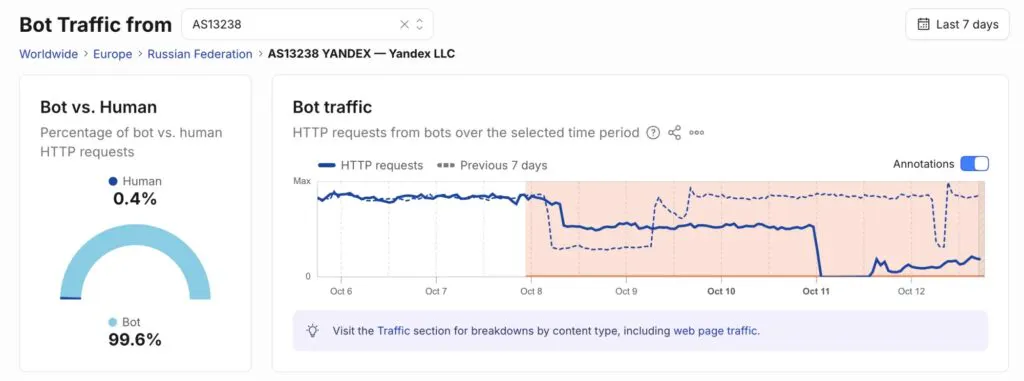
Even when you keep in mind that correlation isn’t causation, this seems like a smoking gun. But if you understand what the numbers mean, they’re not that remarkable at all. As Mashable reports:
The catch is that “automated traffic” and “Russian propaganda bots” aren’t the same thing. Automated traffic is any request sent to a website by software rather than a person. Most of it is mundane, e.g., search engine crawlers indexing pages or monitoring tools checking whether sites are up. Because Yandex runs Russia’s biggest search engine, its network constantly sends out crawlers to index the web. Knocking its data centers offline would bring traffic to a halt regardless of whether a single troll account went quiet.
So we’re back to square one. The fact that “automated traffic” decreased does not, by itself, tell us anything about bot activity. I saw a few other armchair attempts at crunching the numbers, including this analysis, which appears to show that traffic plummeted on various subreddits after the bombings:
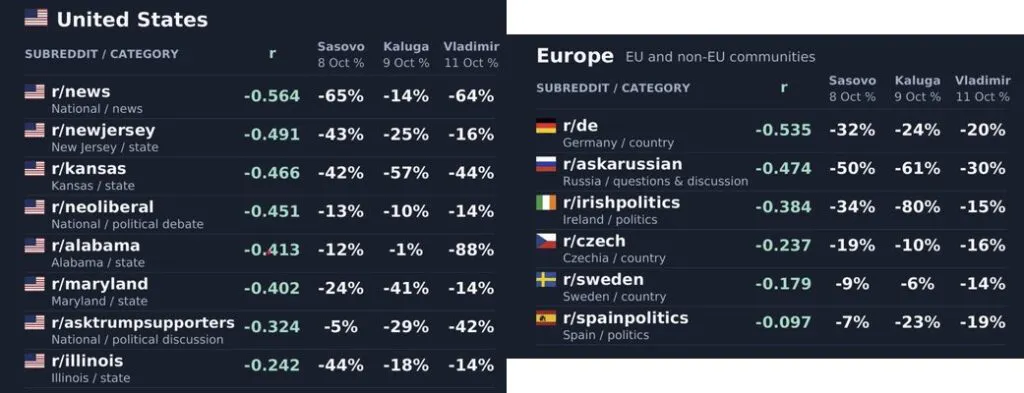
It looks convincing too at first glance. But when you zoom out, you realize it’s highly misleading. They looked at 1,000 subreddits and found that only 90 of them had a “drop in activity” over a three day period. And as the account “Reddit Lies” has pointed out, there’s nothing remotely unusual about that (“Reddit Lies” monitors Reddit all the time, as the name implies, so they have some experience here).
Sometimes, there’s a big event that everyone’s talking about in that community. Then the next day, traffic falls off a cliff. For example, one of the subreddits, which focuses on Czech politics, experienced a 20% drop after the Ukrainian bombings. But the Czech Republic was also holding elections right before the bombings, so you’d expect a spike, followed by a sudden crash. And that’s what happened here. A researcher named Valdemar Osted has confirmed that, according to his analysis, nothing unusual happened on Reddit:
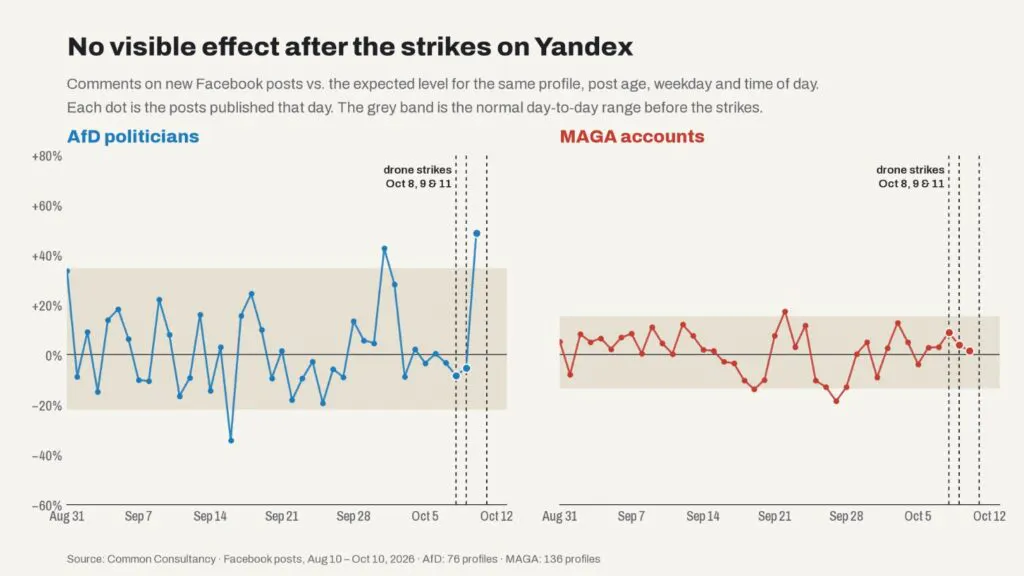
The shaded boxes are the “normal/expected range” for posting levels. Everything was exactly what you’d expect on the right-wing end of the spectrum. I also saw someone else post this chart, supposedly showing that on X, references to “Free Palestine” dropped after the bombings:
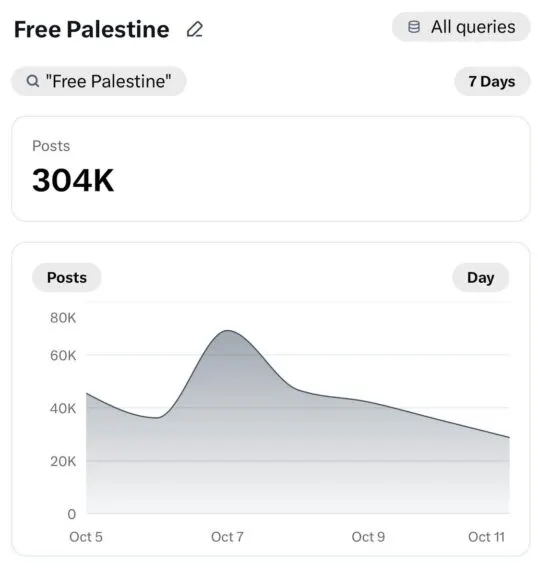
But again, we have no idea whether this is normal noise or not. At a minimum, we can conclude that there is no objective basis for what Zelensky is claiming — which is not a great shock.
That leads us to the more interesting question: What would happen if we actually could somehow eliminate bots from communicating with us on the internet? What if we could revert to the internet of the 1990s and early 2000s when AI-powered bots simply did not exist (or at least, didn’t remotely resemble what we have now)?
To get a sense of how much things have changed, a woman named Elly Maye recently conducted something of an unscientific experiment on Instagram. At the height of the Lindsay Clancy hysteria, she posted the following video on Instagram:
View this post on Instagram
Honestly, when it comes to the quality of female-created Lindsay Clancy content on Instagram, this is probably in the top 5%, or maybe even top 1%. There’s more depth and intellectual horsepower on display in this footage than the vast majority of content women were uploading, unironically, throughout the trial. She does a great job with it. Maybe she could’ve thrown in a few more astrology references, but otherwise, this is pretty much perfect.
The point is, she’s trying to attract bots to comment on her video. She was weeding out humans to see how many bot replies she’d get. And very quickly, some very unusual replies rolled in:
“Don’t give a crap about her disability. More so about her children.” … Retard … “Damn liberal white women in Dahmer glasses.” … “Where is the footage from the police body-worn cameras, why didn’t the police arrest Patrick, Why wasn’t Patrick’s phone examined. … We will be forced to repeal the 19th amendment…”
While this is both entertaining and kind of depressing at the same time, we do have to concede that there’s a pretty big problem with this experiment — which is that she just assumes that all of these responses must be from bots, simply because they have absolutely nothing to do with her video. But as someone who’s been uploading videos online long before the current AI bot epidemic, I have to take issue with this methodology.
Based on my extensive experience, she is vastly underestimating the number of people who will respond to a video with very passionate and lengthy responses without watching any of it. That’s not to say that most people don’t watch the full videos — we have the metrics on that. But when you’re talking about people who leave comments, that’s a demographic that’s very hit-or-miss as far as watching the actual content of the video.
People will leave comments because they want to get something off their chest, so they go to the first video that’s tangentially related to something they’re upset about, and they’ll let loose. People will leave comments because they’re heavily intoxicated and think they’re writing the State of the Union address, which will be personally delivered word-for-word by the President of the United States. People will leave comments for all kinds of reasons that would shock and horrify the typical God-fearing American. That’s not to disparage the good name of many people who comment on my videos because most of them are great. But there’s a very vocal minority of lunatics that drift from YouTube video to YouTube video like a swarm of locusts who are totally unbothered by the content of whatever they’re responding to. With respect to the internet lady running this experiment, she doesn’t appear to have considered that possibility.
There’s no question that, as a general matter, she’s making a legitimate point. From my perspective, it feels like 95% of my X feed is fake now. Comments are fake, posts are fake. Bots will come up with some irrelevant or idiotic take, and then another bot will respond to it. This happens millions of times every day. It’s a particularly big problem on Facebook, where the following image was posted:

It’s a clearly AI-generated picture of a wounded soldier in a wheelchair, with the sign, “Today’s my birthday, No One Love Me Because I’m poor.” And the hashtags on this post, naturally, include “wonderwoman,” “kylie jenner,” “christian bale,” and “angelina jolie.”
The post quickly racked up more than 290,000 likes and 49,000 comments. And yes, most of those likes and comments are fake as well. It’s an endless cycle, and it’s compromised many different websites — from Quora to Reddit to pretty much every other major social media platform.
Then you have the many different AI slop accounts that post fake photos of celebrities doing something incredibly generous or selfless:
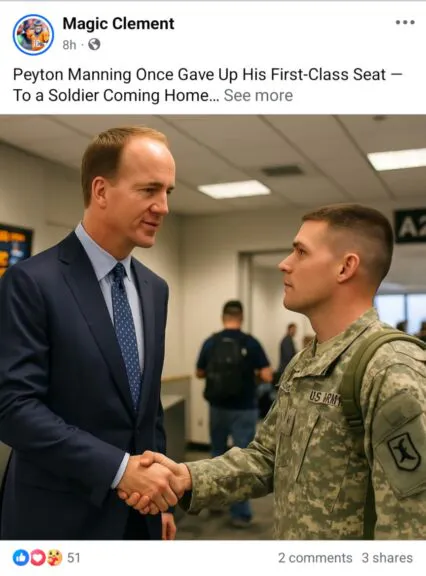
Peyton Manning is one of the more prominent athletes in this genre. The point isn’t simply to trick boomers, although there’s plenty of that going on. The idea is also to scam Facebook’s algorithm into thinking these are legitimate views so the account owner gets the advertising revenue from the post. And this is a totally hands-off process now. You can program AIs to go out and create these posts for you, all day, across every platform you can think of. Realistically, there’s no way to stop the flood of constant garbage.
Just the other day, the DOJ announced that a 54-year-old man named Michael Smith had been sentenced to 18 months in prison for running a similar scam from 2017 to 2024. He was doing this for seven years before he was caught. Here’s what he did, according to the DOJ’s press release. He targeted Amazon Music, Apple Music, Spotify, and YouTube Music in particular:
First, SMITH created thousands of fraudulent accounts on the Streaming Platforms (the “Bot Accounts”) that he could use to stream songs. Second, he used software to cause the Bot Accounts to continuously stream purported songs that he owned, which were generally created using super intelligence. Third, Smith collected royalties based on the fraudulent streams he orchestrated his own Bot Accounts to conduct. SMITH spread his automated streams across thousands of songs to avoid anomalous streaming as to any single song, which would likely cause the Streaming Platforms to discover his scheme. At times SMITH was using as many as 10,000 Bot Accounts at once to fraudulently stream music, and he used fake email accounts and fraudulently-obtained debit cards to create the Bot Accounts. …To obtain the necessary number of songs for his scheme to succeed, SMITH turned to super intelligence, which he used to create hundreds of thousands of AI-generated songs for which he could manipulate the streams. SMITH’s hundreds of thousands of AI-generated songs were streamed by his Bot Accounts billions of times.
Yes, “billions of times.” So his only mistake was getting too greedy. Otherwise, no one would’ve suspected anything. To give you an idea of how brazen this was — in the month of April 2023, Taylor Swift’s entire catalogue received 9.3 million streams on YouTube Music from family plan streams. That same month, according to the DOJ, Smith’s bot accounts used family plans to “fraudulently stream his AI-generated music 80.9 million times” on YouTube Music. As a result, he collected more than $8 million in royalties.
This is why, if you use Spotify’s “Discover Weekly” playlist, you keep coming across terrible covers all the time. Most of them are made with AI for the sole purpose of scamming the system. And because of these scams, the service gets noticeably worse for everyone. We’re seeing this play out all over the Internet. It’s a gold rush for scammers. Meanwhile, people who actually create good content are being drowned out. It’s harder than it’s ever been to get a real audience.
As best I can tell at the moment — and maybe this is self-serving to say, but I think it’s true — the way to survive right now is to have great writing. If you’re a media organization that wants to continue existing in a few years, that’s non-negotiable. You need good writing. The problem is, most writers are generally godawful. That’s why the phenomenon of the “viral article” is dead now, with rare exceptions. That Boston Globe article about the lesbian bar — the one we covered on the show a couple of weeks ago — is the first truly viral article I can remember in months.
This is a change that I’ve seen up close because I was an independent blogger in the early 2010s, which was a reputable career back then. Well, maybe not reputable. But it was a career. All I did was write blog posts. And in doing so, I made enough to support a family. I’d get 4 or 5 million views on a single viral post, easily. I had a post go viral at least once a month. Now that’s impossible. Someone with my exact perspective and skillset, writing the same kind of blog posts today, would have an infinitely more difficult time getting noticed, and if they did get noticed, there’s no way they could scratch out a career just writing long articles or commentaries.
Remember Matt Drudge? Remember how, in January of 1998, he blew open the Monica Lewinsky scandal, because Newsweek had spiked Michael Isikoff’s reporting? They didn’t want to run the story because they couldn’t verify the authenticity of Lewinsky’s conversations with Linda Tripp. So Drudge just went ahead and published it himself. Here’s how the BBC covered that development at the time:
Holding the story wasn’t an issue for Matt Drudge, the maverick Internet reporter who authored the story. Mr Drudge proudly admits that he has no editor but himself. On Saturday, he published the story to the Web’s world-wide audience plus, according to his own calculation, his more than 85,000 subscribers. By the early hours of Sunday, the news had hit Internet news groups. It moved from alt.current-events.clinton.whitewater to alt.impeach.clinton and then to the more mainstream political discussion groups. … In an early interview about the scandal, former Clinton aide, George Stephanopoulos, dismissed the report. “And where did it come from? The Drudge Report. You know we’ve all seen how discredited that’s been.”
This was the moment it became clear to everyone that the mainstream press had lost its ability to control the national narrative for the first time. The Internet gave everyone the ability to become a blogger and to reach an audience of millions. As this scandal broke, people were wondering what the media would look like in 30 years. Would many more websites like the Drudge Report spring up, challenging the established narratives?
Would people still be making those little GeoCities pages about their pets and sharing them with their friends and family? How advanced would those websites be in 30 years? People could only imagine.
What they didn’t expect was that, 30 years later, all of this creativity — all of the value of “surfing the web,” as they called it — would be replaced, in large part, by a flood of AI slop and scams designed to manipulate the algorithm. They probably didn’t imagine that, 30 years after Drudge took down the mainstream press, the Drudge Report would be limping along like a hollowed-out husk of its former self, endlessly aggregating pointless stories that no one cares about. No one thought that, 30 years later, with more websites and podcasts available than ever before, most people would go back to relying on just one or two sources for their daily news and information.
Whatever you call this phenomenon — “dead internet theory” or something else — it’s obviously real. And over in Ukraine, Zelensky has clearly concluded that any politician who promises to bomb our way out of this — even if he’s lying about it — is going to be immensely popular as a result. He’s determined that military action, in the form of drone warfare, is a palatable solution to the “dead internet.”
Is he right about that? It’s really not clear at the moment. But until someone provides a viable alternative, it’s the solution that a lot of people are going to support.
Many more bombs will fall, and many more data centers will inevitably be destroyed. We will continue our march backwards through what they used to call the “Information Age.”
On the bright side, a random guy talking to a camera in his car will have a much better chance at finding an audience and earning a living. That’s a trade many young men would happily make at this point — and as someone who knows a lot about broadcasting from a car, I can’t blame them.
.png)
.png)

